" The house is a museum.
This is magnificent and rare to see so many of them in a residence... It's quite special...."
August 11, 2008 Dr. Robert Winter-California's leading architectural historian and author of "Batchelder Tilemaker" THE Batchelder expert.
From President of Tile Heritage
"Your Batchelder tile installations are significant. Batchelder tiles were commonly used in Southern California homes from the early 1910s through the 1930s primarily on fireplace mantels. What's unusual in this home are the polychrome tiles on the stair risers, a unique combination of pattern and color with a special aesthetic appeal. There is a definite sense of both warmth and welcome to these installations." 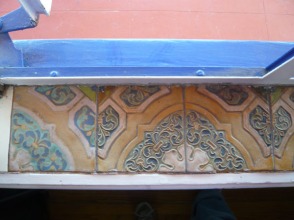 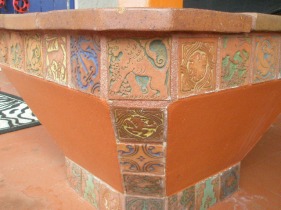 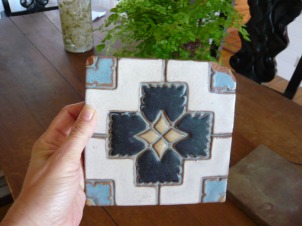 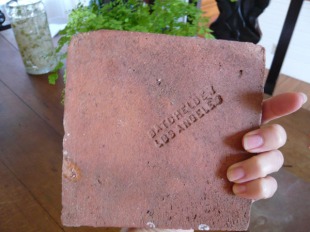 |
Dr. Winter's morning visit August 11th
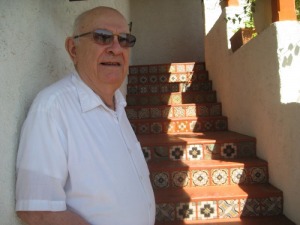
<Photo above: >Dr. Winter in front of Entry stair risers. Over 124 Polychrome Batchelder tiles. 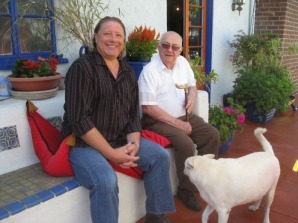 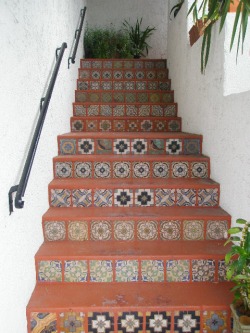 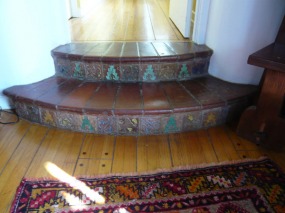  |
Ernest Batchelder and Dr. Robert Winter
Robert Winter Wikipedia, the free encyclopedia .Robert Winter (born 1924) is one of California's leading architectural historians. He is the Arthur G. Coons Professor of the History of Ideas, Emeritus, at Occidental College, Los Angeles. He is particularly known for his contributions to the history of the California branch of the Arts and Crafts Movement. Winter was born in Indianapolis. He received his undergraduate degree (A.B.) from Dartmouth College and his Ph.D. from Johns Hopkins University. Early in his career he taught at Dartmouth, at Bowdoin, and at the University of California, Los Angeles. He joined the faculty at Occidental in 1963 and retired in 1994.
Winter lives in Pasadena in the Batchelder House that formerly belonged to tilemaker Ernest Batchelder.
Winter is the author of numerous books including The California Bungalow (1980) and American Bungalow Style (1996). With David Gebhard he co-authored guides to architecture in northern and southern California.
In 2007 Winter was made a Fellow of the Society of Architectural Historians.
Ernest A. Batchelder (1875~1957) was one of the strongest design personalities in American art-tile production. Born in New Hampshire and educated in Massachusetts, he also trained at the Birmingham School of Arts and Crafts in Britain. He became associated with various American crafts schools, eventually setting up his own school of arts and crafts in Pasadena, California, in 1909. Although he was a writer and potter, he is best known as a tile designer, one very much influenced by the Gothic Revival and the English Arts and Crafts Movement. Among his distinctive cast-ceramic tiles were images of medievalized lions, Art Nouveau peacocks, leaping hares and deer, and Japoniste trees and landscapes. Although very much akin in spirit and subject matter to the painted tiles of William De Morgan, the relief tiles of Batchelder are very much American, with their strong, moulded-relief designs. By 1930, the fashion for the art tile in the United States had diminished to the point where such tiles were regarded as merely utilitarian objects. The Depression forced many commercial firms to close, with art potters turning to university teaching to ensure their financial survival. Indeed, some American tile-producing potteries are still open -- and studio potters still create lovely tiles -- but there is nothing like the popular demand and consequent mass- production that existed in the six decades encompassing 1870 and 1930. However, the significance of American tiles in the history of tile-making has been recognized and interest in them has grown considerably in the last decade, as several museum exhibitions and commercial publications have shown.
Preservation Directory Press:
Press release at:http://www.preservationdirectory.com/PreservationBlogs/ArticleDetail.aspx?id=610&catid=11
